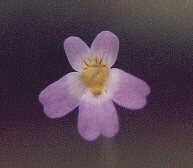
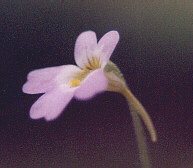
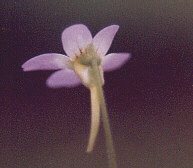
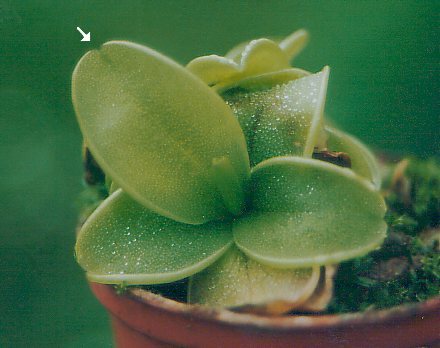
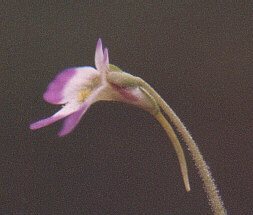
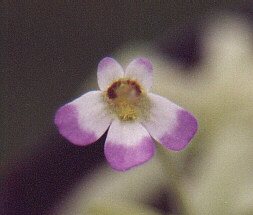
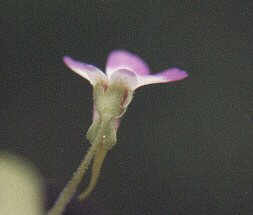
All populations of P. crystallina do not hibernacle in winter. Therefore the species is homophyllous. It has been observed that in winter, especially when temperatures are around the freezing point, the rosette can be much smaller than under warmer conditions. The habitat for this species can vary a lot. Populations are mainly found on vertical limestome cliffs, but also on serpentine. Other populations grow on calcerous wet meadows along small rivers or in sphagnum bogs. A quite extraordinary habitat of P. crystallina ssp. hirtiflora is that of Salerno (Italy), where the plants grow on wet tuffa rocks at sea level, sometimes getting sprayed over by sea water.
Cultivation of this species is not such easy. I have good experience in cultivating them in mini-greenhouses inside under artificial light, where humidity is quite high. As substrate I use a mix of calcerous soil and fine quartz sand to prevent the appearance of fungi due to high humidity. The greenhouses are heated during day at about 24° C, while during night temperatures fall to 12° C. In winter night temperatures are even lower, because I keep the plants in a non-heated room.
I kept the plants also outside during winter. Although this species does not form a hibernaculum, most of the plants survived temperatures of about -15° C (some sites of P. crystallina ssp. hirtiflora are located up to 1600 m above sea level). But I recommend to protect the plants against severe frost.
Until 1991 P. crystallina and P. hirtiflora were considered as two distinct species, but after the re-evalution of the species by A. Strid P. hirtiflora now is not a distinct species anymore but a subspecies of P. crystallina. According to Strid the populations are to closely related as to be considered as two different species.
P. crystallina ssp. crystallina was considered endemic to the Troodos Mountains on Cyprus, but in 1966 there are records from J. Casper that there are also populations on the Turkish mainland (Anatolia). P. crystallina ssp. hirtiflora is a more widespread species. The distribution of this species reaches from the westernmost point in Italy (populations near Salerno and in the Abruzzian Mountains) to Albania, Bosnia-Herzegowina down to Greece.
Pinguicula crystallina ssp. crystallina Sibthorp (1806)
Pinguicula crystallina ssp. hirtiflora (Tenore) Strid (1991)