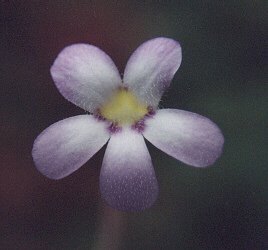
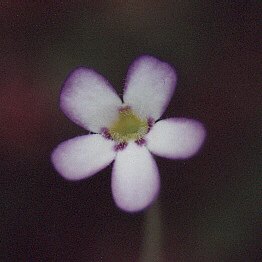
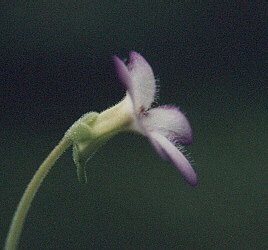
Caracteristic to all agnata-forms is the violet spot at each side at the base of the lobes. But flowers do differ in the coloration of the corolla. While the corolla lobes of the 'El Lobo' clone are of a white colour, the basal portion of the corolla lobes of clone 'Nr.2' is white and the upper half is of a pale violet colour. Clone 'Nr.1' has a white coloration of the lobes with a dark violet margin. There do also exist blue flower forms.
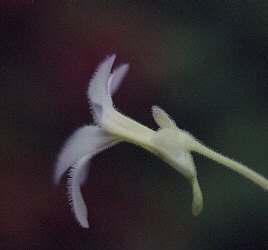
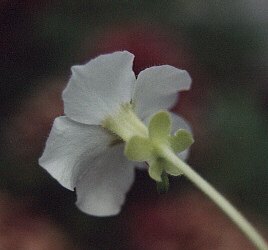
The spur of P. agnata is short, forming an angle of 120-130 degrees to the corolla tube. The end of the spur is rounded. Within the genus Pinguicula the size of the calyx is amongst the biggest. The lobes of the calyx do touch the corolla tube (which is the case for clone 'Nr.1' and 'Nr.2') or they do form an angle of almost 90 degrees to the corolla tube ('El Lobo' form).

Cultivation of P. agnata is quite simple. Plants grow well either in calcerous soil or in an acid substrate (mix of peat and fine sand). As it is the case with many species of the tropical heterophyllous growth type, plants should be kept wet in summer, while in winter watering once a month is recommended, so that the soil only gets damp. Temperature range in winter should be between 10 and 15° C. Propagation is easy. Beside the fact that the plants often do divide spontaneously in winter, leaf cuttings of winter leaves will be the easiest way to obtain new plants.
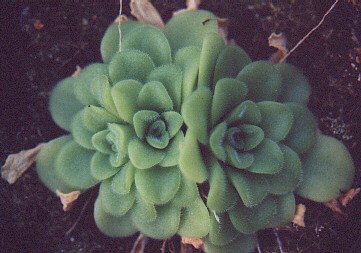
This interesting species was described for the first time in 1963 of plants that were found in the Mexican Federal State Hidalgo, district Zimapan. The plants were growing in an altitude of 1500 m on vertical limestone cliffs. The plants themselves were growing in a more organic substrate. The species were described by herbarium specimens (dried plants). The author was drawing the conclusion, that the species is of tropical homophyllous growth type, but plants in cultivation show clearly, that in winter the species is also forming non-carnivorous leaves. Therefore P. agnata belongs to the group of plants which form two different leaf forms. The winter rosette can reach a size of 5 cm in diameter. The upper surfaces of the winter leaves are densely clothed with white non-secretory hairs.
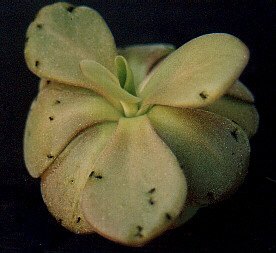
I cultivate several clones of P. agnata. The plants do differ in form and coloration of the leaves. There are also differences in form and colour of the corolla lobes.
The summer rosette of P. agnata 'Nr.1' consists of pale green spatulate semi-erect leaves, up to 10 cm long. The summer leaves of P. agnata 'Nr.2' and 'El Lobo' are more obovate and show a pale red coloration when exposed to sunlight. The corolla of P. agnata is caracterized by 5 equal lobes. The form of the corolla lobes ranges from wedge-shaped ('Nr.1', 'Nr.2') to obovate ('El Lobo'), whilst the lobes of the latter form are slightly overlapping.