P.
mundi grows at wet places on vertical limestone rocks. The plants either do
grow in moss or in eroded limestone sand, that is accumulating in holes or crevices
of the rock or under a layer of algae. The species belongs to the temperate growth
type (that means, that the plants overwinter with a winter bud (latin: hibernaculum).
The plants do form 2 types of leaves. Beginning of April the first spring leaves
do appear out of the winter bud, which mainly do grow half erect and do have an
elliptical to obovate form with upturned margins. The summer leaves are more of
an alongated form up to 10 cm long with a leaf margin that is ondulated and barely
upturned. Beginning of May the first flowers appear out of the summer rosette.
Flowering time normally ends beginning of July, but here and there plants in flower
can still be found even in mid of July. The authors of the species reported that
P. mundi also does form stolons, but up to now I could not confirm this
particularity.


The
calyx is very similar to the one of P. vallisneriifolia, the flower is
two-lipped and can reach a size of up to 2,5 cm n diameter. The outermost part
of the crolla lobes are of a violet or pale violet colour, whereas the basal part
of the lobes are white. Near the throat the corolla lobes show a dark violet veination.
The middle lobe of the lower lip is densely covered with white hair and the entrance
of the tube is of a cream colour. The spur is with a size of up to 1,3 cm in length
quite long. The tube is short and has as wide and funnel-shaped form. On the outer
part of the tube there are almost no glandular hair present.


The
chromosome number is mentioned with 2n = 48. This differs strongly from the chromosome
number of all other Spanish butterwort species (with the exception of
P.
dertosensis, that also posseses 2n = 48 chromosomes). This leads to the
assumption, that
P. mundi could be of hybridogenous origin, eventually
derived from a cross between a species with 2n = 32 chromosomes (e. g.
P. vallisneriifolia)
and a species with 2n = 16 chromosomes (that is to current knowledge not existing
anymore in Spain) and the following doubling of the chromosome number. Recently
it was reported that there should be a second location of
P. mundi in the
Serrania de Cuenca existing.
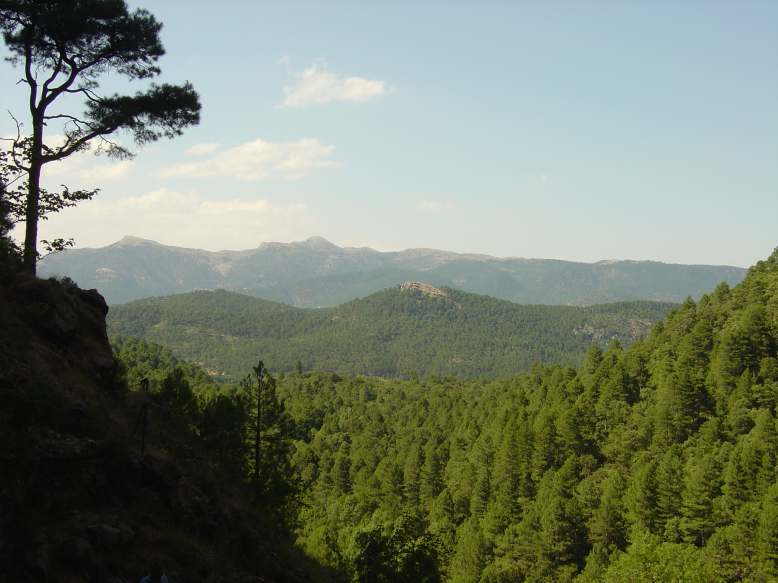
It's hard to believe that until the late 80's the population
that is growing in the canyon of the Mundo river in the Sierra de Alcaraz (province
of Albacete) was always considered as P.
vallisneriifolia, as the morphological differences of these plants are
striking. Only in 1986 Blanca and colleagues described the population as a distinct
species and named it after the location, where the plants are growing, the Rio
Mundo, as P. mundi.